Editing Services Portfolio Info and FAQ Our Process About Contact

Professional Book Editors

The fiction editing team that cares about your story as much as you do. Discover the best version of your manuscript with high-quality developmental editing, copy editing, beta-reading, and proofreading.

Request a Free Sample Edit

No commitment. No risk.  ·  2-day turnaround on samples.

Words Edited

475,086

Editors on the Team

3

Sample Edit Turnaround

2 Days

Years of Experience

20+

Experienced Editors and Lovers of Fantasy and Science Fiction

If you're looking to hire a professional book editor for your fiction manuscript, you're in the right place. Our team has more than two decades of experience in more than just editing — we're readers, writers, and love being hands-on in the story creation process.

We accept manuscripts of all sizes and genres, including incomplete drafts, but have a slight preference and specialization for Fantasy and Science Fiction.

Our Editing Services

Premium Tier

Developmental Editing

The deepest level of editing, focused on the big-picture elements of your story — structure, pacing, character arcs, plot, tension, and worldbuilding. We work at the level of the story itself, not the sentence.

Every developmental edit includes a full editorial assessment — a detailed written report identifying your manuscript's strengths and the specific changes that would strengthen it. In-document comments are used for targeted notes that reference the assessment directly.

All Tiers

Copy Editing

Focused on clarity, consistency, and correctness at the sentence level. We address grammar, syntax, word choice, repetition, and flow — everything that affects how smoothly your prose reads without altering your voice.

All copy edits include in-document comments explaining the reasoning behind significant changes, so you understand every decision and stay in control of your manuscript.

Standard Tier

Beta Reading

A professional reader's perspective on your manuscript before it goes further. We read your work the way your target audience would, then provide honest, structured feedback on what's landing and what isn't.

Our beta read goes beyond personal opinion — we evaluate engagement, pacing, character relatability, and genre expectations, giving you actionable insight from readers who understand fiction deeply.

Basic Tier

Proofreading

The final pass before your manuscript is ready for submission or publication. We catch spelling errors, punctuation mistakes, formatting inconsistencies, and any remaining grammatical issues that slipped through earlier stages.

Proofreading assumes your manuscript has already been edited. If you're not sure which service is the right starting point, our free sample edit will help you figure that out.

We edit fiction exclusively, across all genres and manuscript sizes — including incomplete drafts. Our team has a particular specialization in Science Fiction and Fantasy.

What Sets Us Apart

We're Readers First

Our team came to editing through a love of fiction — not the other way around. We've spent years writing, self-publishing, and reading deeply in the genres we edit. If your shelves include Sanderson, Tchaikovsky, or anyone building worlds that demand a second read, you're in the right place.

Quality Without the Price Tag

Professional editing should be accessible to writers at every stage — not just those with a publisher's budget behind them. We've built our pricing to sit at the quality end of the market without putting it out of reach. Your story deserves serious editing. It shouldn't cost you a serious compromise to get it.

Try Before You Commit

Handing your manuscript to an editor takes trust. We make that easier with a free sample edit — up to 3,000 words, returned within two days, with no obligation to continue. See exactly how we work, how we communicate, and what our edits look like on your writing before you decide anything.

No Surprises, Ever

Every project is backed by a signed contract with clear scope, pricing, and timelines laid out before any work begins. You'll always know exactly what you're getting and what it costs. If something isn't clear, we're easy to reach — and we'd rather over-communicate than leave you guessing.

We Don't Disappear After Delivery

Most editing relationships end when the file lands in your inbox. Ours doesn't. Once your manuscript is back with you, we're still available to answer questions, clarify our reasoning, and think through your next steps together. Your story doesn't stop being our concern the moment the work is technically done.

What Our Clients Say

This was my first time working with a professional editor. Matthew was kind and professional.

A.J. Graf

Myths and History of the Giftgiver

The feedback I received was spot on. As it's my first book, his guidance was pivotal in making me understand how to approach the story. Very happy with his services.

Bobby D'Buze

Blades & Blood — The Way of the World

Read full review

ProjectK Publishing provided invaluable insight, cutting through that heady complexity to bridge the gap between my vision and the audience. They opened up the world in ways I hadn't fully considered, making the story more accessible without losing its soul.

Gourab Koley

The Misery Market Pt.1

Read full review

Frequently Asked Questions

Can't I just self-edit my book? +

You absolutely can — and to a degree, you should. At least one or two self-editing passes is an important step in the editing process, especially if you made changes partway through your manuscript. But it's also important to understand where self-editing falls short if your objective is to publish a polished story.

It's common for writers to be too close to their own work. We naturally develop blind spots to weaknesses in the story, or even basic punctuation errors. We've seen it with hundreds of frustrated self-publishing authors who've done countless passes and still missed basic mistakes. If you're one of those people, it doesn't mean you're a bad writer. It just means you're human like the rest of us.

Our position: self-editing is important, but it isn't the end-all-be-all. Even the most experienced writers with decades behind them don't edit entirely on their own.

What is developmental editing and do I need it? +

Developmental editing, essentially the same thing as structural editing, is the process of examining a manuscript's story elements (plot lines, characters, setting) to identify weaknesses and propose fixes that strengthen them. At ProjectK Publishing, there's no limit to what we'll propose to improve your story. That might mean adding or removing entire characters or plot lines, rearranging chapters, or expanding on existing worldbuilding to amplify its presence and utility in the story.

Our developmental edit includes an editorial assessment, a companion document delivered alongside the edited manuscript. In the assessment, we clearly outline the issues and the steps to correcting them, done in tandem with comments and bookmarks inside the .docx file for easy cross-referencing.

If the answer to: "do I want to publish a good story?" is: yes, then you need a developmental edit. That might sound like an exaggeration, but it isn't. It's far too easy to get too close to your story and miss the glaring issues. It's also very common to overlook logical gaps because you already know what's happening six chapters from now while your reader doesn't.

When is my book ready for an editor? +

At ProjectK, we encourage you to reach out at any stage of your writing process, but whether the help will be impactful depends on what you need. If you're confident in your story and looking for polish, we suggest finishing the manuscript, completing one or two self-editing passes, and then contacting a professional editor.

If you're stuck partway through your story, or you're looking at your outline and suddenly seeing the holes — please reach out. It's much easier to address problem areas before they grow large and unwieldy, and sometimes that means taking a pause mid-draft and seeking help.

What makes a good book editor? +

For us, it comes down to three core traits: attention to detail, creativity, and strong communication skills. Attention to detail is especially important for copy editors, line editors, and proofreaders; they must remain consistent and attentive across an entire manuscript. Creativity plays a smaller role for proofreaders but is central for developmental and line editors. Strong communication skills might be the most unexpected of the three, but we'd argue it's the most important.

Being able to communicate clearly within our team, and to convey our feedback clearly to the client, is absolutely paramount. It's not hard to find an editor who does good work. It is hard to find one who communicates clearly and takes the time to understand you and your story. When you're making the all-important decision of choosing an editor, a strong communicator is non-negotiable.

How is a team of editors different from working with an individual? +

It's not as simple as 3 editors = 3x the quality or speed of a single editor. But there's a reason publishing houses use a team rather than one editor working alone — the best editing teams are structured around each other's strengths and weaknesses.

At ProjectK, our process works like this: Margaret, our Senior Editor, starts the manuscript first with a copy editing pass — making notes, in-manuscript edits, and comments as she works. Once she's roughly a third of the way through, Ryan, our Junior Editor, begins his line editing pass on the sections Margaret has already cleaned up. Like Margaret, he leaves comments, edits, and story notes for collaboration.

When both have completed their independent passes, Matthew begins reading the edited manuscript and making notes for the developmental edit. In parallel, Margaret conducts the final proofreading pass, verifying Ryan's work and occasionally expanding on his line edits. When Matthew finishes reading, the team meets to discuss the story and collaboratively formulate the editorial assessment. It's a genuinely collaborative process, and we're able to deliver so efficiently because each editor amplifies the others.

How much does book editing cost? +

The cost of editing your book varies based on the size of your manuscript(quick note: please be wary of anyone claiming to produce high-quality edits for a flat fee). Because of the flexibility of our editing tiers, most clients see a fee between $350 USD and $2,000 USD. Visit our Editing Services page to use our pricing calculator and instantly estimate the cost of your project.

How does the free sample edit work? +

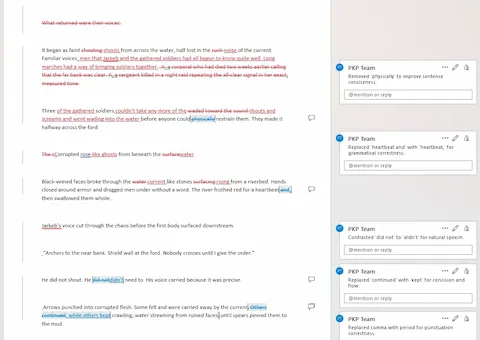
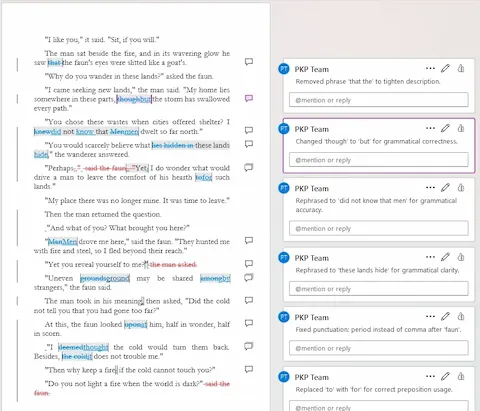
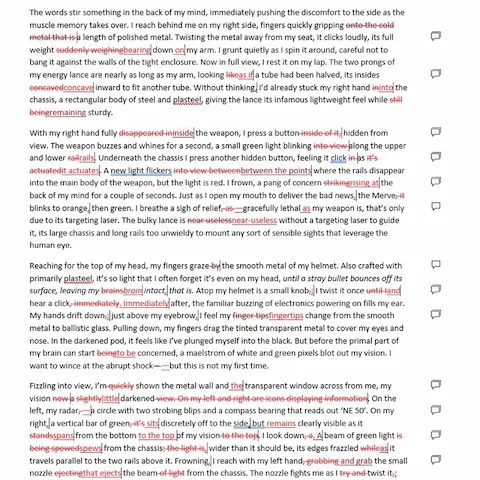
It's very simple, visit our Editing Services page and fill out the form. You'll be prompted to attach your sample document. Please ensure it's in .docx format and editable. We'll return an edited version with tracked changes enabled so you can approve or reject our edits as you see fit.

Why Your Writing Quality Matters More Than You Think

I had this question come up recently with a prospective client, and I'll restate what I told him. Broadly, there are three sticking points that will turn a reader away from your book — and they address them in chronological order, like a checklist.

First: your book just isn't what they're looking for. There's nothing you can do about this reader, assuming your cover and product description are strong. Either your story aligns with what they want and you gain a reader, or it doesn't and they move on. That's fine.

Second: the book is poorly written. Humans have evolved over millennia to detect patterns, and most readers can tell within five pages whether a book is well written. A tolerant reader might push through, but a manuscript riddled with errors will turn away even the most patient. Writing quality is the first filter readers apply — especially if you're a new or unproven author.

Here's a simple way to think about it: a poorly written book might cause 60% of readers to put it down within the first few pages. Of the 40% who continue, they'll only keep going if the story is also good. The numbers are flexible, but the principle holds. A well-known author with strong social-media traction might only see a 20–30% drop-off because readers trust the story is worth pushing through for. An unproven author with only a handful of Amazon reviews might see drop-offs of 80–90% the moment the reader loses confidence in the writing.

It's also worth noting: a poorly written book rarely generates bad reviews, because most readers who don't finish won't bother leaving one. But if your story is genuinely engaging and your writing is rough, expect a string of 2–3 star reviews from readers who cared enough to finish and were frustrated enough to say so.

Third: the story isn't engaging. This refers to the story elements themselves; often a plot that drags, characters that feel flat or unlikable, a setting that has no relationship to the people in it. Readers usually can't make this judgement until they're a few chapters in, which is exactly why clearing the writing quality hurdle first matters so much.

And here's the counterintuitive part: even though an engaging story is the last thing readers consciously evaluate, it's ultimately what determines whether your book succeeds. A well-written story that fails to engage will still fail. But you'll never get readers far enough to find out if your writing doesn't hold them first.
Your story deserves a second set of eyes.

Request a free sample edit — up to 3,000 words, returned within two days, with no obligation to continue. See exactly what we do and how we do it before you commit to anything.

Still have questions? We're easy to reach and happy to talk through anything before you decide.